On not drinking milk

Back in 2011, a London company launched the world’s first breast milk ice cream. The response was predictable. Everyone frothed at the mouth about how disgusting it was…and then went back to sipping their lattes.

It’s a funny old thing social conditioning. It tells us drinking the milk from cow udders is entirely normal, while consuming the milk produced by our own species is taboo. And yet, logically, we all know that neither is what nature intended. Mammal milk is designed for mammal babies – hopefully of the same species as the lactating mother. It’s not meant to be drunk past infancy, in any shape or form.

But, I hear you say, it’s tradition, innit? In northern Europe we’ve been drinking milk for thousands of years. It’s one of the cornerstones of our diet, it’s where we get our calcium and, well, CHEESE!

And yes, of course, I can’t disagree that dairy has long been one of the pillars of Western culinary culture. But, obviously, the whole tradition argument never works. After all, it’s the tradition of the Yanomami tribe of Venezuala to make and eat a soup out of the ash left over after cremating a loved one. It once was an Inuit tradition to leave elderly people on ice floes to die when food was scarce. And it’s still tradition for one half of the human race to assume superiority over the other half, purely on account of what’s in their pants. Just because stuff’s being going on a long time, doesn’t make it ok.

And digging further down into the whole ‘tradition’ argument, it’s illuminating to consider just how milk drinking started in the first place. You see, for most of our existence, we weren’t milk drinkers at all. Homo Sapiens first appeared on the plains of Africa around 1.8 million years ago, but we only decided to start ingesting the milk from another animal’s teat around ten thousand years ago. For the huge interim period – i.e. most of our time on Earth – we were hunter-gatherers living in nomadic groups. We killed animals with our spears, but we didn’t nick off with their babies’ milk.  It was only after the agricultural revolution that dairy came on the menu.

For most of history milk was toxic to adult humans, because we couldn’t produce the lactase enzyme required to break down lactose, the main sugar in milk. As babies and small children we could digest the lactose in our mother’s milk, but the gene that allowed us to do so switched off as we grew up, to make way for the breastfeeding of younger siblings. After the agrarian revolution, a mutation appeared in certain populations that left this gene switched on for life.

This mutation happened two or three thousand years after humanity started tinkering around with dairy consumption. Around ten thousand years ago, when humans were just starting to settle down to an agricultural way of life, cattle herders in the Middle East began fermenting milk to reduce the amount of lactose in it, so they could eat it. They created the first yoghurt and cheese. They still couldn’t drink milk, however. The trait of lactase persistence emerged around 7,500 years ago, in what we now know as Hungary. It subsequently spread around Europe (vast swathes of the world’s population, particularly in Asia, still remain lactose-intolerant today).

The questions is why did these ancient farmers feel the need to persist in trying to drink milk? There have been many hypotheses. For a while, academics thought humans might have evolved to tolerate lactose because they lacked vitamin D and could obtain it from dairy. However, this idea only made sense because at the time the researchers also thought that milk drinking began much further north. Now we know it started as far south as Budapest, this argument doesn’t make sense. There’s too much sunshine, the main source of vitamin D.

The more recent idea is a whole lot more surprising. It seems likely that people started drinking milk because their health deteriorated after the agricultural revolution and they needed a new source of nutrition. Yes, that’s right, settling down in one place, planting crops and raising animals actually took a toll on the quality of people’s health. They became dependant on a handful of crops, after eons of a highly diverse foraged diet, and so consumed less nutrients. What’s more, these crops were dependent upon a whole range of variable conditions, including the weather, soil quality and water drainage. They frequently failed, creating food shortages in a populations that no longer just upped sticks and moved on when faced with hunger. Evidence shows that Neolithic farmers suffered tooth decay, anaemia and low bone density. Their height dropped five inches below that of their Stone Age ancestors. When a famine broke out, those who could stomach the milk meant for livestock’s babies were more likely to survive – and their genes to live on. In this way, the associated gene became ubiquitous in European populations.

So it seems that the roots of our milk drinking tradition lie in ancient farmers’ attempts to avoid malnutrition. They took it up to try and fight off starvation, rampant disease and low infant mortality rates. Putting dairy in this context makes you look at the continuation of the habit in the modern world a little differently. There’s simply no need for well-off people in rich, urban societies to drink milk.

But, but…calcium!

I hear you. I really do. The Milk Marketing Board and then Dairy UK have done an amazing job of convincing everyone that we need milk products for strong bones and teeth. But the truth is that there are better sources of calcium out there. Don’t just listen to me though, listen to the most advanced medical school on the planet. Harvard University says that the best source of calcium isn’t dairy, partly because of its links to three of Western society’s top five killers. Milk contains a high percentage of unhealthy saturated fats. Consuming too many of these causes a build-up of cholesterol in your arteries, which, in turn, can lead to heart attacks and strokes. Dairy products have also been linked with increased risk of ovarian and prostrate cancers.

The simple fact is you don’t need to ingest cow booby juice to get enough calcium. You can obtain calcium from kale, cabbage, watercress, rocket, broccoli, pak choi, molasses, figs, oranges, almonds, tofu, pinto beans and sesame seeds. I mean, our prehistoric ancestors managed to do so for millennia, right? And in the modern world which country has the longest life expectancy? That’s right, it’s Japan, a country where most people can’t even stomach milk.

There’s even a question mark hanging over how absorbable the calcium in dairy is. A study by John Hopkins University in Maryland, USA, showed that the increase in the intake of dairy products in China and India between 1999 and 2004 didn’t result in an increase in people’s average calcium levels. In fact, the trend seems to be that greater dairy consumption results in greater risk of osteoporosis. The bone thinning disease is more common in dairy-eating countries. You’re more likely to break a hip if you’re an older woman in Scandinavia than in Asia or Africa, where little or no milk is consumed.

The only pro-milk argument left is, well, CHEESE! But I’m going to leave that little gem for a whole separate blog post another day. In the meantime, just look at this little cutie…

Consider the notion that you’re stealing its food because some starving Neolithic farmers got so desperate they decided to try drinking the fluid produced by the mammary glands of one of its distant ancestors.

Now, go and enjoy that cappuccino!


Vegan eats – Vegan Junk Food Bar, Amsterdam


Too many people think a vegan diet is all about deprivation.

‘Oooh, but you’ve got to eat something nice sometimes!’ a family member once said to me, under the popular misconception that my daily diet consists of a handful of mung beans, a slither of tofu and lashings of self-righteous indignation.

The truth is I LOVE food and have always enjoyed cooking. And since I changed to a plant-based diet, I’ve never cooked more or eaten better. There is a whole new world of ingredients and recipes out there to explore. If you’re a foodie it’s not limiting, it’s really, really exciting. I’d been so stuck in a culinary rut before and now I’m trying out new flavours all the time. What’s more, while I eat healthily most days, junk food is still on the menu. That’s right, folks, being vegan doesn’t mean you have to eat quinoa-based Buddha bowls every night. You can still feast on burger and chips.

As a case in point, on a recent trip to Amsterdam I sought out an eating place I’d long since read about. Vegan Junk Food Bar does what it says on the tin. It’s a plant-based fast food joint that combines fries and ethics. To say it surpassed my expectations is an understatement. It was completely and utterly amazing!

There are three branches in the city, but I went to the one on Staringplein, which is a burger bar. The menu is short and to the point: a beef style burger, a chicken style burger and a selection of fries, as well as some meat-free bitterballen, the Dutch snack that’s minced up beef in breadcrumbs and deep fried (sort of like, erm, a bovine Scotch egg without the egg, so perhaps not really like a Scotch egg at all…).

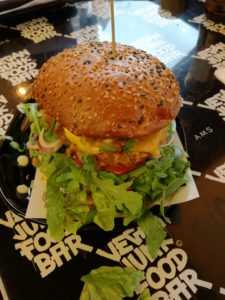
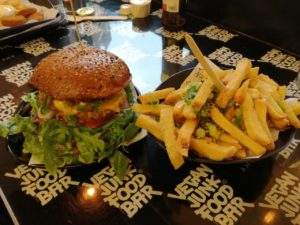
I had a Daddy McChik’n, which is basically a chicken-style burger with plenty of salad, pickles and plant-based cheddar. Now it’s a long time since I’ve had an actual chicken burger, but it was 100% delicious. I stuffed it down me so quickly my nine-year-old dining companion raised her eyebrows. I also ordered a side of fries with truffle oil and a yummy plant parmesan called ‘Parm a san’, which was made from dried onions and the terribly-named-but umami-packed Nutritional Yeast (I know, I know, it sounds awful, but it’s a store cupboard essential if you’re going animal-product-free, trust me. It provides a sort of nutty, cheesy hit). Everything was lip-smackingly good, but the mayonnaise I had on the side was literally the best egg-free mayo I’ve ever tried: rich, creamy and unctuous. Even better, because Vegan Junk Food Bar is in one of the coolest, most cosmopolitan cities in Europe, you can enjoy a beer with your burger (courtesy of some local craft brewers, natch). Here’s what the Daddy MChik’n and the side of truffle fries looked like:

The afore-mentioned nine-year-old, who is what’s known as a flexitarian (i.e. she eats veggie and/or vegan most of the time, but succumbs to the lure of a chipolata at friends’ parties), had the chik’n nuggets off the kids menu and proclaimed them far superior to the actual chicken nuggets she’d insisted in ordering at a restaurant several days before. Here they are, in all their meat-free glory.

This is exactly the place to take any sceptics who think veganism’s all about denial. It’s not! It’s about kindness, sustainability and the joy of stuffing as many chips in your gob as you can in 15 minutes. Here’s hoping Vegan Junk Food bar – and its brilliant message – comes to the UK soon.

Another three easy ways to live more sustainably

An area of rainforest half the size of Paris has recently been cleared in Papua, Indonesia.  The ice melt at the South Pole is nearly as bad as that of the North. The UK government is privatising our forests by stealth.

The endless stream of bad news about the environment is so unremitting and overwhelming that it usually feels easier to close your eyes, stick your fingers in your ears and shout ‘tra, la, la!’ rather than do anything about it.

But you can do something. You can.

And you really should.

Of course, the corporate giants who are driving climate change need to be stopped – but that needs to go hand-in-hand with a widespread cultural shift. We all need to change the way we live and there are so many things you can do to get started. Here are three examples:

  1. Order a fruit and veg box from a local farmer – Local produce has travelled the shortest distance and so is by far the most eco-friendly. Most fruit and veg box schemes also tend to use very little in the way of plastic packaging – another huge advantage over buying produce from supermarkets.
  2. Go organic – if you can afford it. This might seem like a self-indulgent luxury, but I assure you it’s not. Planet Earth is on the brink of a soil crisis so grave that it threatens all life upon it. If we carry on farming the way we are now – using pesticides, chemical fertilisers and intensively-planted monocultures – the UN says there are only 60 years before our soil will become infertile. We need to change the way we farm and fast – reverting to organic permaculture. To bring this revolution about, help organic farmers by buying as much of their produce as you can.
  3. Invest in a reusable takeaway coffee cup – In the future I bet we’ll look back on our current disposable coffee cup habit the way we now look back on litterbugging. Or mullets. In the UK, we get through a staggering 2.5 billion single-use coffee cups a year. Most aren’t recycled, because of their interior’s plastic coating. We’ve all seen the Blue Planet clips and know what that means for marine life. It’s a disaster. But do you know that scientists have discovered that plastic is now so rife, it’s made its way up the food chain and onto our plates?  And you don’t need to be a doctor to understand that the implications for our health – and that of our children – are not good. So, unless you’re prepared to drop that morning macchiato habit, buy yourself a reusable cup. You can get one here, here or here. Even better, many coffee shops now offer a discount for anyone providing their own cup. So it’s a win for both you and the sea turtles.                                                                                                                                                                                             

On becoming vegan and being British (and not a millennial)

‘How do you know if someone’s vegan?’

‘Don’t worry, they’ll tell you!’

I saw this joke on a birthday card recently. I laughed so much I nearly split my hemp trousers. Because vegans, of course, are a bunch of preachy, self-righteous killjoys who love nothing more than yakking on about veganism all the time and making people feel guilty about enjoying the odd bacon sandwich. Or so the stereotype goes. Even though plant-based eating is enjoying a surge in popularity, the mainstream media and popular culture are full of this kind of stuff. In fact the adjective most often paired with the word ‘vegan’ in certain media outlets is the carefully considered ‘militant’*. Like trying to eat a more environmentally friendly diet that benefits not only animals, but also other humans and my own health makes me some kind of confrontational extremist who likes to phone up dairy farmers and scream ‘Rapist!’.

When I became vegan myself these negative associations made me more than a little worried about other people’s reactions. So I turned to vegan social media feeds, blogs and magazines for advice. The overwhelming consensus was that all new vegans will find themselves constantly fielding questions about their lifestyle choice, so to make sure to have lots of answers  ready by swotting up on the facts and figures. That way when Auntie Jean asked if I’d still refuse to eat meat if I ever found myself living a hunter gatherer lifestyle, I’d know how to respond. This is such a known thing that there’s even a game doing the rounds on social media about it. It’s called ‘Defensive Omnivore Bingo’. Vegans are to tick off a question whenever someone asks them it.

But here’s the thing. My bingo card remains unmarked. I haven’t crossed off a single thing. You see, my experience is that when people find out you’re vegan, they don’t ask you about it. And because I don’t want to be preachy, I don’t feel like I can offer up any information unasked. So we end up just not talking about it. Which means I’m left with all that information buzzing around my brain about how eating tofu could save the world for the next generation and no outlet for it (which maybe explains this blog!).

Now, I’m going to indulge in a bit of stereotyping of my own and say that I think this might be because I’m British – and also, perhaps, because I’m not a spring chicken. When we find something difficult to talk about, us mid life Brits tend avoid it. It’s perhaps why so many of us still end up talking about the weather. I think when a lot of Brits sense a conversation could be headed in what they fear might be a slightly tricky direction, they often veer away from it (I’m guilty of this myself). Unfortunately, the fact so many people think veganism is a tricky subject in the first place is all down to that misinformed stuff they’ve read or seen. And therein the British 40-something vegan paradox lies…

*Just like when vegetarianism was a relatively new thing and every time it was written about it was paired with the word ‘strict’, as in ‘Ooh, she’s a strict vegetarian.’ Which always made me wonder what a non-strict veggie looked like. Someone who intermittently broke up a diet of nut roasts and mung beans with the odd dish of braised liver?

On eating only plants

Two years ago I decided only to eat plants. Yes, that’s right, I became one of those pesky vegans. Contrary to popular opinion, I didn’t do it because I wanted to make people feel guilty about ordering a cappuccino or to drive my mother-in-law crazy about what to serve me for lunch. I didn’t even do it to assuage my concerns about animal welfare.* No, I was motivated first and foremost by the environment.

As a mum – and a member of the human race generally – I’m pretty keen for our species to survive. I mean, ideally I’d like us to flourish – you know, come to our senses, get rid of the numpties currently in charge, start being nice to each other, discover more about this weird and amazing universe we find ourselves in and, potentially, even colonise it. But I’ll settle for us just existing.

Sadly, all the scientific evidence suggests that we’re pretty much doomed, unless we ditch the meat and dairy. It’s one of those annoyingly inconvenient truths. Your burger and your latte are destroying the environment.

It’s quite simple, really. Animals require lots more land and water to farm than plants. When you farm animals you need both land for them and land on which to grow their feed. On a small planet with nearly eight billion people that’s not a good look. Much deforestation is due to people clearing land to farm animals, particularly cattle. What’s more, the millions of tonnes of methane that animals, like cows, release into the atmosphere makes animal agriculture even more toxic.

As one University of Oxford academic has pointed out, if we all turned vegan, we could drastically cut greenhouse gas emissions.

A few facts:

  • Globally, 18% of the dangerous greenhouse gases driving climate change come from animal agriculture. This is more than all emissions from transport combined. Emissions from the world’s cars, planes, boats and trains are less than those created by rearing animals for food (see this seminal United Nations report for details).
  • Livestock farming creates 37 % of all human-induced methane emissions. Methane is at least 20 times more potent than carbon dioxide (CO2) and so 20 times more dangerous for our climate. (Hey, I thought cow farts were funny too, until I read this Intergovernmental Panel on Climate Change report and realised they could be the reason the world doesn’t meet the Paris Agreement targets).
  • The World Bank estimates that 91% of Amazonian deforestation is due to animal agriculture. Yup, it’s good to donate to celeb-fronted rainforest charities, but you could also swap that steak for a chickpea burger.

We might live in a world in which those in charge don’t listen to experts. But, when it comes to animal agriculture and the climate, the experts are telling us the same things. Over and over and over. Personally, I’d never, ever thought I’d go vegan. But once I knew the facts, it became the obvious thing to do. I didn’t want my daughter thinking I’d chosen a cheese sandwich over her future.

(*But the more I learn about the cruelty of modern animal farming**, the more I’m glad I don’t support it.

**And yes, sorry, this includes dairy farming.)


Eco-friendly Christmas stockings

It was only when I had my daughter that I really started worrying about the environment. With a little person to care for, I suddenly saw the existential threat of climate change for what it really was. I mean, what was the point in making sure her carrot puffs were organic, with out-of-control global warming on the cards? She doesn’t need just her own health. She needs a healthy world to live in.

So since she came along, I’ve made some eco-friendly lifestyle changes. I’ve become vegan. I don’t drive. I’ve switched to a green energy provider. My latest quest is to cut down on plastics. And here’s where things have come unstuck. You see, while I diligently refill washing-up liquid, laundry liquid, fabric conditioner and shampoo bottles with eco-friendly products, I’ve not stopped buying my little girl the endless plastic gubbins that seems an integral part of modern childhoods. Her bedroom is awash with plastic kittens, jewellery, hair accessories, play phones, false teeth, clockwork toys and a whole load of the neoliberal propaganda that is Shopkins – which means I’m buying environmentally damaging stuff for the person who motivated me to take action for the environment. That’s not just irony eating itself, that’s irony eating itself, sicking itself up and then eating itself all over again.

The plastic tat has to stop. I’m haunted by visions of tropical beaches awash with plastic ponies, their pink flanks fading slowly in the sun. Those things will take thousands of years to decompose – harming countless marine animals in the process.  But it’s so much easier to make changes for yourself, rather than enforce them on your child – especially when, like all kids nowadays, my daughter has plastic pushed at her from all sides.Take children’s magazines. Long gone are the days when the ‘free’ gift was an annual event. Today every issue comes with a whole load of ‘free’ plastic bric-a-brac attached – all handily held in place by plastic packaging (even the fabulous National Geographic Kids does this!). Birthday party goody bags are another plastic-fest. It’s someow become the done thing to help destroy the future of every single kid at the party by cheerfully waving them off with a load of brightly dyed, moulded petro-chemicals. And the Christmas stocking is the same. Apparently nothing says “you’ve been a good boy/girl” than a clockwork dinosaur or a fortune-telling fish. The result is what you see in the photo – a load of plastic guff that ends up in drawers, down the back of the sofas or discarded somewhere inconvenient (usually the bathroom floor, readily positioned for a barefoot).

So this Christmas, it’s time for a change. I’m not saying my daughter’s getting a tangerine and a 5p piece in her stocking. But Santa is definitely going to be more eco-conscious. I’m thinking books, chocolate, packets of seeds, wooden beads, a cinema ticket, dried mango or other fruit, a home-made jar of biscuit mix, mini soaps, pencils, mini sewing kits, socks, a bath bomb, a green science kit and a groovy hat If anyone has any other ideas, please let me know!